

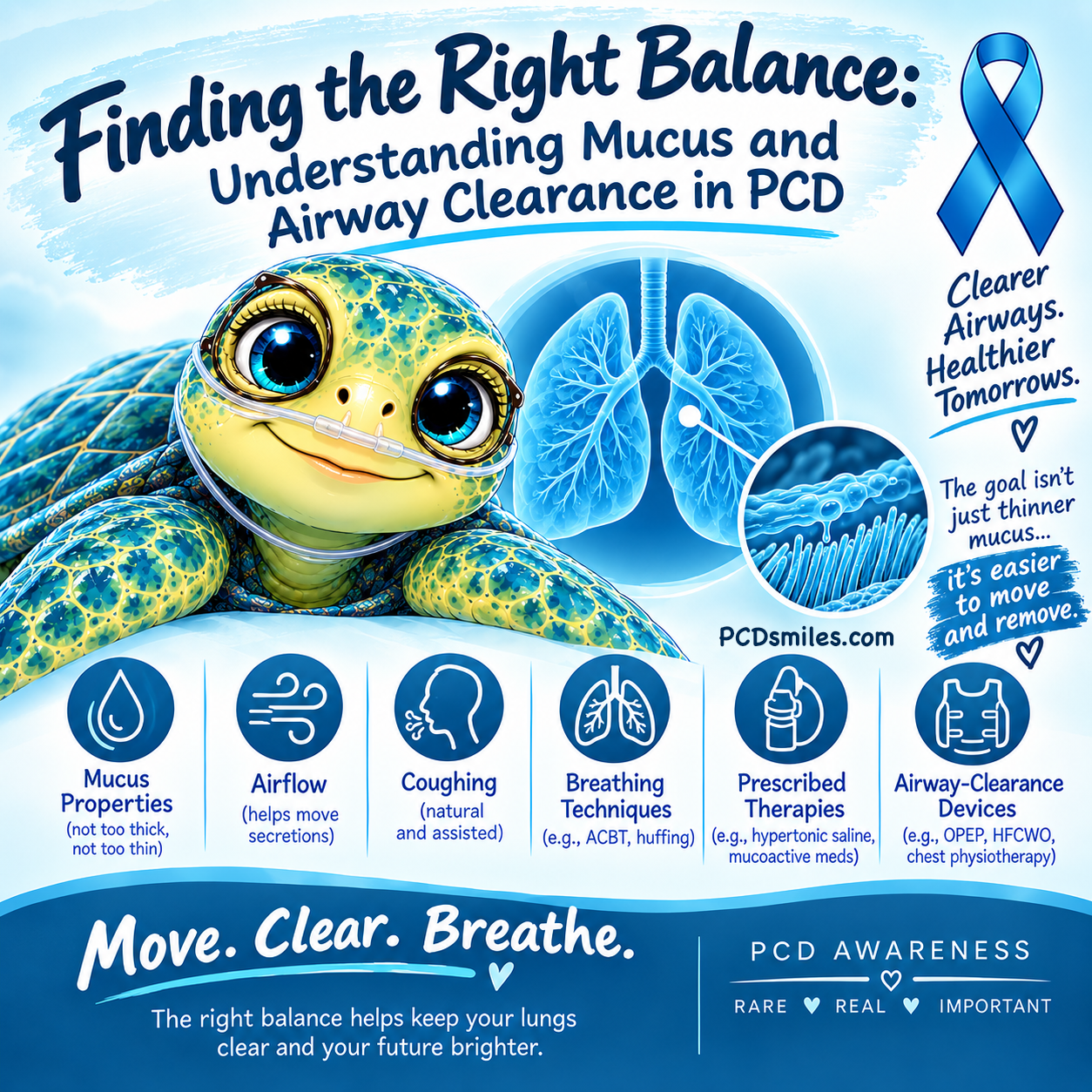



For people living with Primary Ciliary Dyskinesia (PCD), keeping mucus moving is a daily part of protecting the lungs.
PCD is a genetic condition that affects the tiny, hair-like structures called cilia that normally help move mucus, bacteria, and other particles out of the respiratory tract. When those cilia don't work properly, mucus can remain trapped in the airways, contributing to
chronic coughing, recurrent infections, inflammation, and, over time, lung damage such as bronchiectasis.
Because mucus retention is such an important part of PCD, many people use treatments designed to hydrate, loosen, or mobilize airway secretions. These can include nebulized saline, mucoactive medications, breathing techniques, and mechanical airway-clearance devices.
But there is an important concept that can sometimes get overlooked:
The goal isn't necessarily to make mucus as thin as possible. The goal is to make it easier to move and remove.
Why Mucus Consistency Matters
Healthy airway clearance depends on a complicated relationship between mucus, the fluid surrounding the cilia, the airway lining, airflow, coughing, and ciliary movement.
In PCD, the cilia aren't working normally, so people often rely much more heavily on coughing and airway-clearance techniques to compensate.
That means the physical properties of mucus matter.
Mucus needs to be mobile enough to move through the airways, but it also has physical properties that allow airflow, huffing, coughing, and airway-clearance devices to interact with it.
Think of it this way:
Airway clearance needs something to move.
If secretions are extremely thick and sticky, they may be difficult to mobilize.
But changing secretions into an extremely watery fluid does not automatically guarantee that they will be easier to remove.
The ideal balance can vary from person to person.
Is "Thinner" Always Better?
It's tempting to think:
Thinner mucus = easier clearance.
But airway clearance is more complicated than that.
Mucus is not simply a substance that needs to be dissolved. It needs to be mobilized and expelled from the lungs.
If secretions become excessively watery, the way they interact with airflow and airway-clearance techniques can change.
For some individuals, this may potentially make clearance feel less effective.
However, it is important to distinguish this concept from an established medical rule: there is not enough evidence to conclude that routinely over-thinning mucus causes a specific, predictable increase in lung infections in everyone with PCD.
The response to mucoactive therapies can vary significantly between individuals.
The Goal Is Mobilization, Not Just Liquefaction
Airway clearance can involve several forces working together:
Mucus properties + airflow + coughing + airway structure + breathing techniques + mechanical therapies
When these work together effectively, secretions can be moved from smaller airways toward larger airways and eventually expelled.
This is why treatments that modify mucus are often used as part of an airway-clearance strategy, rather than as a replacement for airway clearance itself.
For someone with PCD, the important question isn't simply:
"How thin is my mucus?"
It may be more useful to ask:
"Can I effectively mobilize and clear my secretions?"
When Clearance Doesn't Feel Effective
Everyone with PCD can experience airway clearance differently.
If you are spending significant amounts of time performing airway clearance but feel that secretions aren't actually moving, that is worth discussing with your PCD care team.
Possible symptoms to discuss include:
- A persistent rattling or "gurgling" sensation in the chest
- Feeling that mucus is present but won't come up
- Increasing difficulty clearing secretions
- Changes in the amount or character of mucus
- Increasing cough or shortness of breath
- More frequent respiratory infections
- A noticeable change in how well your usual airway-clearance routine works
These symptoms do not prove that mucus has been over-thinned. They can have many possible causes.
The important message is that a change in your usual airway clearance deserves attention rather than simply adding more mucus-thinning treatment on your own.
Mucoactive Treatments: Finding the Right Approach
People with PCD may use treatments intended to improve the hydration or movement of airway secretions.
One example is hypertonic saline, which is inhaled through a nebulizer and can help hydrate airway secretions and facilitate clearance in some people.
Other medications or treatments may be used depending on an individual's specific circumstances.
But more treatment isn't automatically better.
The appropriate therapy, dose, timing, and combination of treatments should be determined with a healthcare professional familiar with PCD.
Airway Clearance Still Does the Heavy Lifting
One of the most important principles is that loosening mucus is only part of the process.
The mucus still needs to leave the lungs.
That may involve:
- Huff coughing
- Active Cycle of Breathing Techniques (ACBT)
- Positive Expiratory Pressure (PEP)
- Oscillation and Lung Expansion (OLE)
- Oscillating PEP (OPEP)
- Chest physiotherapy
- High-frequency chest wall oscillation
- Other individualized airway-clearance techniques
The best approach varies from person to person.
For someone with PCD, the goal is to develop a routine that actually results in effective and sustainable secretion clearance.
Why One Person's Experience May Not Match Another's
PCD is genetically and clinically diverse.
Two people with PCD can have very different:
- Ciliary defects
- Mucus characteristics
- Lung function
- Airway structure
- Infection histories
- Bronchiectasis severity
- Responses to airway-clearance techniques
- Responses to inhaled therapies
That means there isn't necessarily one universal "perfect" mucus consistency or one airway-clearance routine that works for everyone.
A treatment that makes one person's secretions easier to clear may feel very different to someone else.
Don't Change Your Treatment Based on Mucus Alone
If you believe your mucus has become too thin—or too thick—don't independently increase, decrease, or stop prescribed treatments.
Instead, talk with your pulmonologist or PCD care team.
They can look at the bigger picture, including symptoms, lung function, infection history, airway-clearance effectiveness, and your response to specific treatments.
Your care team may be able to adjust the treatment, timing, sequence, or airway-clearance technique rather than simply adding more medication.
The Real Goal: Effective Clearance
PCD isn't about winning a contest to see who can produce the thinnest mucus.
The goal is much more practical:
Make secretions manageable.
Move them out of the airways.
Reduce retained mucus.
Protect the lungs.
Airway clearance works best when mucus properties, airflow, coughing, breathing techniques, and prescribed therapies work together.
So rather than thinking:
"How thin can we make the mucus?"
A better question may be:
"How effectively can we get the mucus out?"
That distinction matters.
Because with PCD, the goal isn't simply to change the mucus. The goal is to clear the lungs.
Be sure to join us tomorrow for another conversation about primary ciliary dyskinesia.
Join our Facebook group Turtle Talk Café today.
We have several ways that you can donate to PCD Smiles;
- Visit Smile E. Turtle's Amazon Wishlist
- For more information on how you can donate, please visit our "Donation" page to check out our "Do & Don't policies.
- Or sponsor a PCD Smiles cheer package today!
- To shop for your “Official” turtle care ribbon gear today, visit PCD Style
Thank you for your consideration!
Medical Disclaimer
This article is intended for general educational and informational purposes only and is not a substitute for professional medical advice, diagnosis, or treatment. Infection risks and appropriate prevention strategies can vary considerably between people with PCD based on their lung health, respiratory cultures, treatments, age, and other medical conditions.
This article is for educational purposes and does not establish that over-thinning mucus causes increased infection risk in people with PCD. Responses to airway-clearance and mucoactive therapies vary. Any changes to prescribed treatments should be discussed with a healthcare professional familiar with PCD.
Cleaning and disinfection recommendations for respiratory equipment can also vary by device and manufacturer. Always follow the instructions provided by your healthcare team and equipment manufacturer.
Do not start, stop, or change medications, airway-clearance treatments, infection-control practices, or other aspects of your medical care based solely on this article. If you have PCD and are concerned about an infection, worsening respiratory symptoms, or possible exposure to a pathogen, contact your PCD or respiratory healthcare team for individualized guidance.
If you are experiencing severe or rapidly worsening breathing difficulties or another medical emergency, seek urgent medical attention.