

Why primary ciliary dyskinesia may involve more than simply “cilia that don't work”
Primary ciliary dyskinesia (PCD) is an inherited disorder in which the structure, formation, or movement of motile cilia is abnormal. Throughout the respiratory tract, these microscopic hair-like structures normally beat in a coordinated fashion to move mucus, trapped particles, and microorganisms toward the throat, where they can be cleared.
When those cilia don't beat properly, mucociliary clearance is impaired. Mucus and bacteria can remain in the airways, contributing to recurrent respiratory infections, chronic inflammation, progressive airway damage, and bronchiectasis.
But there is another layer to the story.
Cilia aren't merely tiny “brooms.” They also participate in sensing the physical environment of the airway.
That distinction may help explain why mucus problems in PCD can be considerably more complicated than the simple statement that “the cilia don't move.”
The airway has a built-in mucus-hydration feedback system
Healthy airway mucus has to be a delicate balance.
It needs to be viscous enough to trap particles and microorganisms, but hydrated enough that beating cilia can move it efficiently. The airway therefore has mechanisms that continuously monitor and regulate the physical properties of the mucus layer.
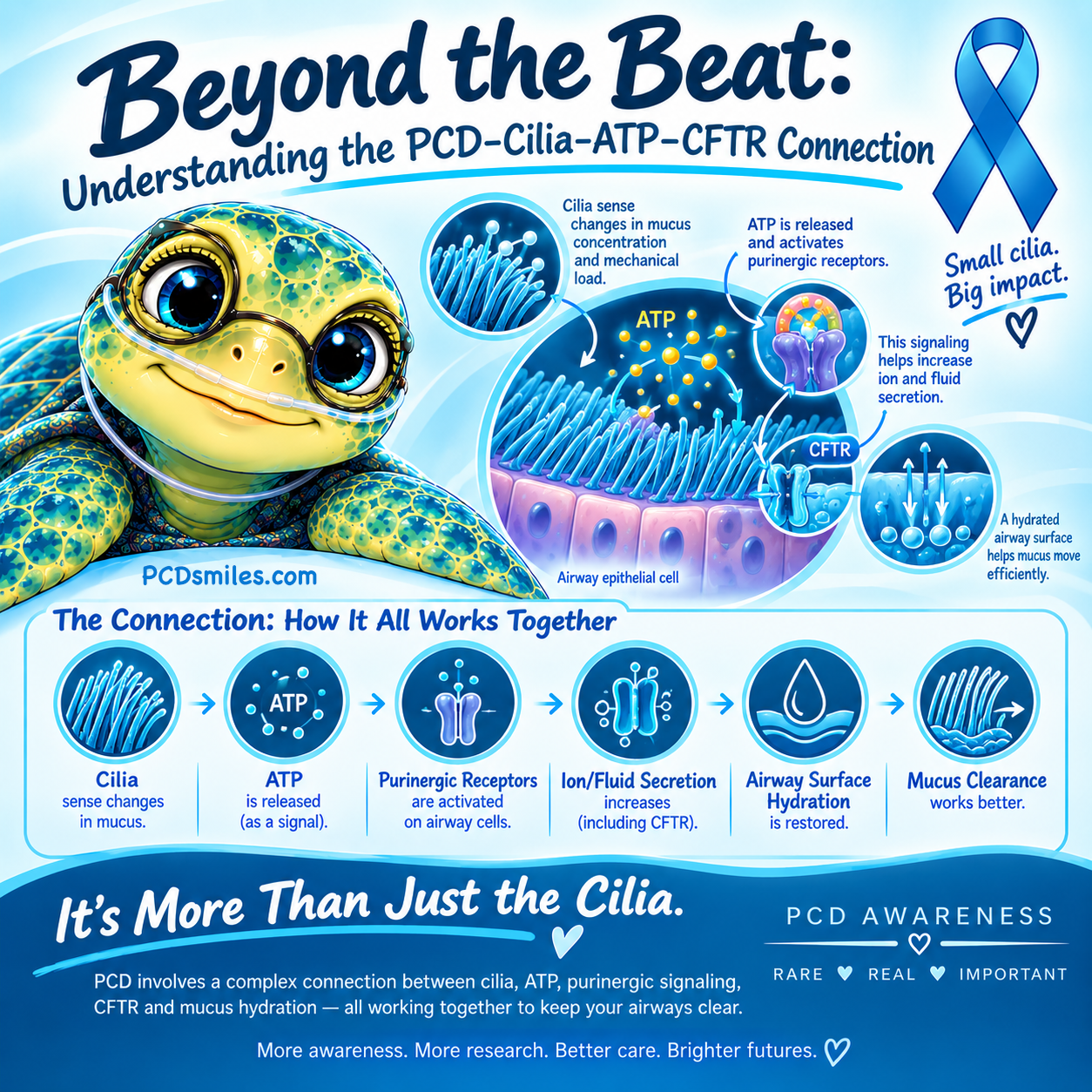
Research has demonstrated that motile cilia can sense changes in mucus concentration and mechanical load. When mucus becomes more concentrated or dehydrated, the mechanical forces acting on the cilia can stimulate the release of ATP from airway epithelial cells.
ATP in this context isn't primarily about energy for the cell. It also acts as a signaling molecule.
The released ATP interacts with purinergic receptors on airway epithelial cells, initiating signaling that increases epithelial ion and fluid secretion. CFTR is one of the ion channels involved in this broader airway-fluid regulatory system. The resulting movement of ions and water helps restore hydration of the airway surface liquid.
In simplified form:
Mucus becomes concentrated
↓
Motile cilia sense the increased mechanical load
↓
ATP is released
↓
Purinergic receptors are activated
↓
Ion/fluid secretion increases
↓
Airway-surface liquid becomes better hydrated
↓
Mucus becomes easier to transport
It is a remarkably elegant feedback loop.
What changes in PCD?
In PCD, the problem begins with the cilia.
Depending on the underlying genetic cause, cilia may be absent, structurally abnormal, immotile, or beat with an abnormal waveform. Consequently, they cannot perform normal mucociliary clearance.
But experimental work has suggested that the consequences may extend beyond the physical inability to move mucus.
In airway cultures containing non-motile PCD cilia, researchers found that the cells did not respond normally when mucus became more concentrated. In other words, the defective cilia could not properly participate in the mechanosensory feedback that normally increases ATP signaling and fluid secretion.
That creates a potentially important vicious cycle:
Abnormal ciliary movement
→ impaired mucus clearance
→ mucus becomes increasingly concentrated/abnormal
→ defective cilia cannot adequately sense and respond to that change
→ diminished ATP/purinergic signaling
→ inadequate fluid response
→ mucus becomes harder to clear
→ more mucus retention
This does not mean that people with PCD have a genetic CFTR defect.
It means that normal ciliary function is part of the system that helps regulate airway-surface hydration, and disrupting that system can contribute to abnormal mucus behavior.
So does PCD cause thick, sticky mucus?
This is where the science becomes particularly interesting.
For years, the major distinction taught between PCD and cystic fibrosis (CF) has been straightforward:
CF: abnormal CFTR → abnormal ion and water transport → dehydrated, concentrated mucus.
PCD: abnormal cilia → impaired mucociliary clearance.
That distinction remains fundamentally important.
However, emerging research suggests that the physical properties of mucus in PCD deserve considerably more attention.
A recent study found that airway mucus from people with PCD has altered viscoelastic properties, including increased elastic and viscous components and changes in the structure of the mucus gel. The findings suggest that mucus dysfunction in PCD is not simply a matter of mucus being present but unable to move; the mucus itself can have abnormal physical characteristics.
And in 2026, researchers at Indiana University School of Medicine in Indianapolis reported another potentially important PCD phenotype: inherent mucus hypersecretion in patient-derived airway epithelial cells.
Together, these findings are helping broaden the scientific picture of PCD.
The disease may involve an interconnected problem involving:
- defective ciliary motion
- impaired mucociliary clearance
- abnormal mucus secretion
- altered mucus viscoelasticity
- chronic infection and inflammation
- disrupted airway-surface homeostasis
Rather than thinking of PCD as simply “bad cilia,” it may be more useful to think of it as a disorder of the airway clearance system.
PCD and CF: Similar consequences, different starting points
This distinction matters enormously.
Cystic fibrosis is caused by disease-causing variants in the CFTR gene, which produces the CFTR protein. Defective CFTR function disrupts epithelial ion and fluid transport and is a major driver of airway mucus dehydration and concentration.
PCD, by contrast, results from pathogenic variants affecting genes involved in ciliary structure, assembly, motility, or related processes.
So it would be inaccurate to say:
“PCD is a CFTR disease.”It isn't.
But it is also increasingly incomplete to say:
“PCD has nothing to do with CFTR.”
The relationship is more subtle.
Motile cilia participate in a signaling network that can regulate airway fluid secretion, including signaling that affects CFTR-mediated ion transport. Experimental work has shown that this cilia-dependent response to mucus concentration is impaired when cilia are non-motile.
That's a fascinating connection.
Why this matters for people with PCD
PCD and CF can share several clinical features, including chronic respiratory infections, sinus disease, mucus retention, and bronchiectasis.
That overlap can make diagnosis challenging.
But similar symptoms do not mean identical biology, and the distinction matters because the underlying diseases and their management are different.
A person with PCD deserves recognition of the underlying ciliary disorder rather than having the entire problem viewed through a CF framework.
At the same time, researchers are increasingly asking whether aspects of airway-surface hydration, mucus biology, purinergic signaling, and ion transport could eventually become relevant to understanding or treating PCD.
That is an area where additional research is needed.
The vicious cycle: mucus, infection, inflammation, and airway damage
Once mucus isn't being cleared effectively, microorganisms can remain in the respiratory tract.
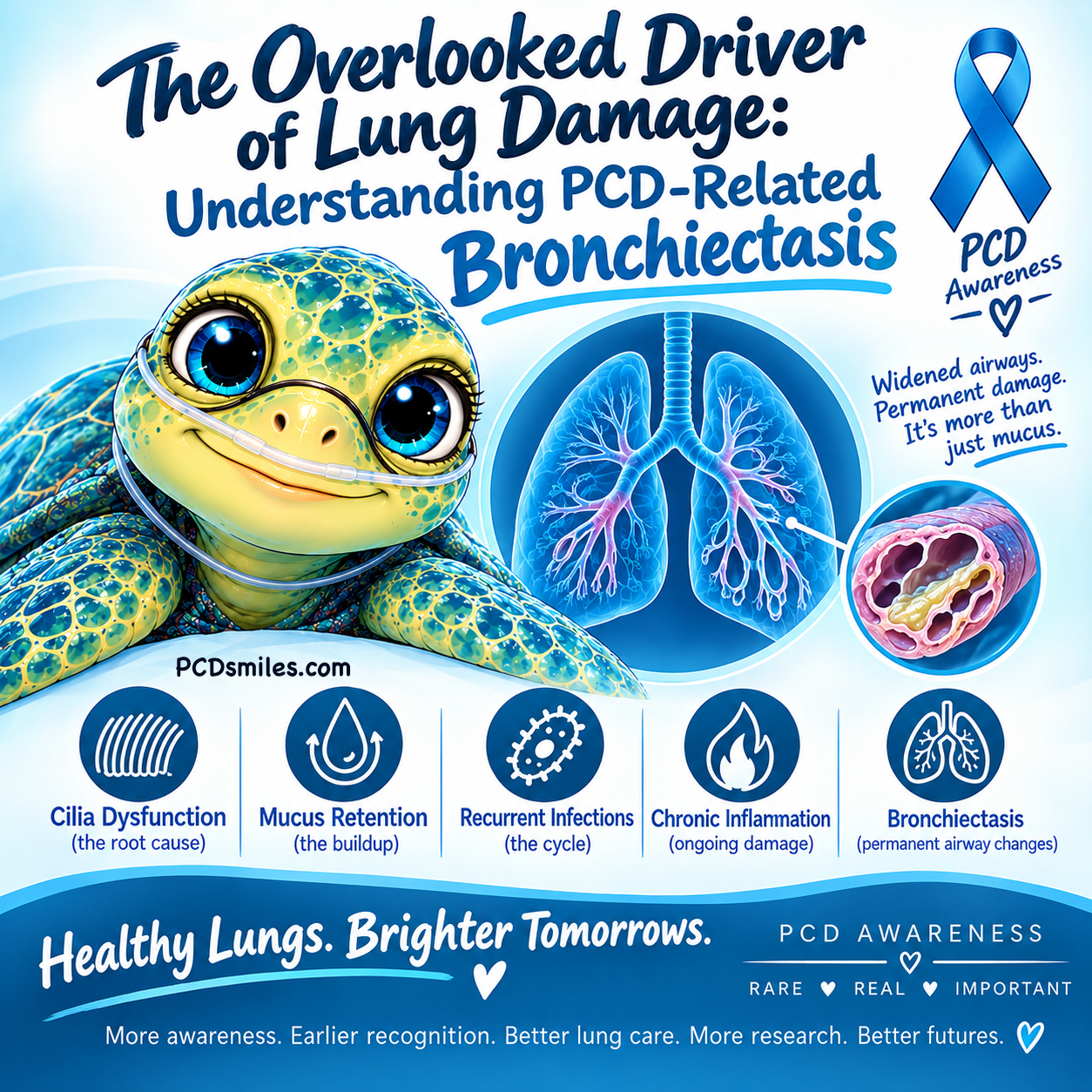
Persistent infection and inflammation can damage airway walls. Over time, repeated cycles of infection, inflammation, mucus retention, and tissue injury can contribute to bronchiectasis, in which portions of the airways become permanently widened and structurally damaged.
This can make clearance even more difficult.
The result can become a self-reinforcing cycle:
Ciliary dysfunction
↓
Poor mucus clearance
↓
Mucus retention
↓
Bacterial persistence
↓
Inflammation
↓
Airway damage
↓
Bronchiectasis
↓
Even more difficult mucus clearance
And this is one reason early recognition and appropriate management of PCD are so important.
“It's not just about the cilia.”
That may be the most important message.
PCD begins with ciliary dysfunction, but the consequences extend throughout the airway environment.
The cilia interact mechanically with mucus.
They participate in sensing changes in the mucus layer.
That sensing can influence ATP release.
ATP participates in purinergic signaling.
Purinergic signaling can regulate epithelial ion and fluid secretion.
CFTR is part of that larger system.
And all of these processes influence whether the airway surface remains sufficiently hydrated for effective mucus clearance.
When the cilia are dysfunctional, the mechanical clearance mechanism is impaired—and the signaling system associated with ciliary sensing may be impaired as well.
That is a much richer story than simply saying:
“People with PCD can't clear mucus because their cilia don't work.”
They can't clear mucus effectively because an entire interconnected airway-clearance system has been disrupted.
A rapidly evolving picture of PCD
Perhaps the most encouraging part of this story is that researchers are continuing to uncover mechanisms that weren't fully appreciated before.
The Indiana University research published in 2026 adds another piece by identifying inherent mucus hypersecretion in patient-derived PCD airway cells.
Other research has demonstrated altered mucus viscoelasticity in PCD, while earlier experimental work established the importance of motile cilia in sensing mucus concentration and regulating ATP-dependent airway-fluid responses.
These findings don't erase the fundamental definition of PCD.
They expand it.
And that expansion matters because better understanding of the biology can lead to better recognition, better research questions, and potentially better therapies.
Small cilia. Big impact.
PCD is rare, but its effects can reach far beyond a microscopic cellular structure.
The cilia influence mucus clearance.
Mucus influences infection.
Infection influences inflammation.
Inflammation contributes to airway damage.
And now we're learning that the cilia may also participate in the signaling mechanisms that help keep mucus properly hydrated in the first place.
Understanding those connections may be an important part of understanding PCD itself.
Because sometimes the most important discoveries happen when researchers stop looking at one piece of the puzzle and start looking at how all the pieces communicate.
PCD awareness isn't just about knowing that the cilia don't work.
It's about understanding what happens when they can't move, sense, signal, and help maintain the delicate environment that keeps the airways clear.
Be sure to join us tomorrow for another conversation about primary ciliary dyskinesia.
Join our Facebook group Turtle Talk Café today.
We have several ways that you can donate to PCD Smiles;
- Visit Smile E. Turtle's Amazon Wishlist
- For more information on how you can donate, please visit our "Donation" page to check out our "Do & Don't policies.
- Or sponsor a PCD Smiles cheer package today!
- To shop for your “Official” turtle care ribbon gear today, visit PCD Style
Thank you for your consideration!
Medical Disclaimer
This article is intended for general educational and informational purposes only and is not a substitute for professional medical advice, diagnosis, or treatment. Infection risks and appropriate prevention strategies can vary considerably between people with PCD based on their lung health, respiratory cultures, treatments, age, and other medical conditions.
Cleaning and disinfection recommendations for respiratory equipment can also vary by device and manufacturer. Always follow the instructions provided by your healthcare team and equipment manufacturer.
Do not start, stop, or change medications, airway-clearance treatments, infection-control practices, or other aspects of your medical care based solely on this article. If you have PCD and are concerned about an infection, worsening respiratory symptoms, or possible exposure to a pathogen, contact your PCD or respiratory healthcare team for individualized guidance.
If you are experiencing severe or rapidly worsening breathing difficulties or another medical emergency, seek urgent medical attention.